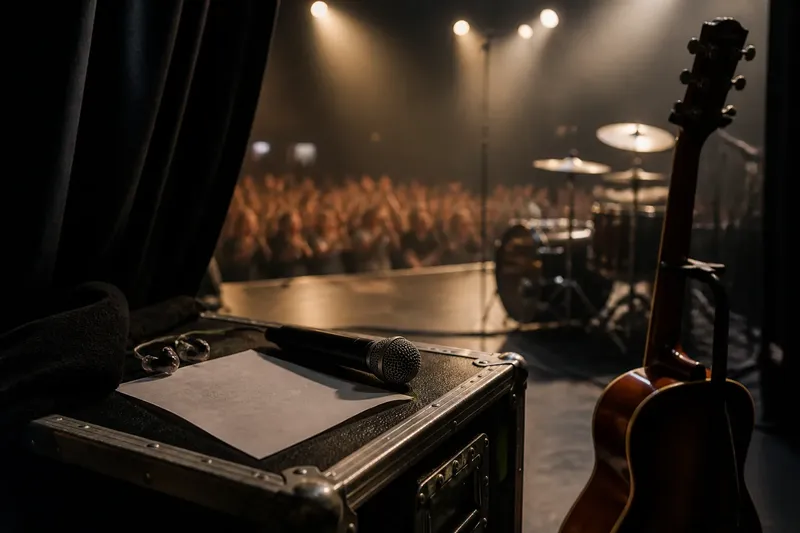
Why a Set List Feels Like a Journey
Why a set list feels like a journey: follow recurring sounds, shifts in mood, and musical replies to hear how a concert’s sequence changes its meaning.

You’re halfway through a concert when a familiar bass line returns, though the song has changed. That small recognition can make the room feel different: the new piece seems to be answering something you heard earlier. To understand why a set list feels like a journey, listen for those relationships, not just for favorite songs arriving one by one.
Start by noticing what the opening teaches you
The first song gives your ears a starting point. It may set a physical mood with a brisk beat, introduce a repeated guitar figure, or establish a singer’s close, conversational delivery. You do not need to decide whether the opener is the best choice. Just register the sound and feeling it puts in the room.
Keep the observation simple. Think “bright and clipped,” “low and patient,” or “voices up front.” These are useful listening notes, not verdicts. If the next song changes the atmosphere, you have a contrast to follow. If it extends the opener’s mood, you can hear the set deliberately holding its ground.
At a show, let the first transition happen before reaching for your phone. The memory of one sound is clearest when the next one arrives.
Follow a change without labeling it too soon
As the set continues, notice what changes between songs. The shift might be obvious, such as a move from a spare acoustic arrangement to a full band. It might be subtler: the same tempo, but a sharper vocal delivery, or a familiar chord pattern under a more uneasy lyric.
Listen across a few dimensions, rather than using “up” and “down” as shorthand for everything:
- Texture: Does the arrangement add instruments, strip them away, or leave more space?
- Energy: Does the performance become more forceful, restrained, restless, or settled?
- Point of view: Does the singer sound newly confident, uncertain, playful, or distant?
- Sound: Does a rhythm, tone, or vocal shape recall something from earlier?
One change can matter more than several loud contrasts. A singer who delivers a new song quietly after a run of emphatic numbers may make restraint feel like a choice, not an absence.
Listen for a later song that answers an earlier one
A set list can create a conversation between songs separated by several minutes. The later piece may repeat a melodic contour, return to an image, or reverse an earlier song’s emotional stance. A listener does not need to know whether the band planned that connection. The audible relationship is enough to make the sequence feel shaped.
Imagine a fictional concert that opens with a song about leaving, played with brisk drums and a bright guitar. Later, the singer performs a slower piece about arriving somewhere unfamiliar, using a similar guitar pattern but leaving more space around the voice. The later song may seem to revise the opener: departure sounded free at first, but now carries uncertainty. The observable clue is the returning pattern, and the changed delivery gives it a different shade.
When you hear a possible reply, ask what has changed. Has the repeated sound become softer, heavier, or harder to place? Does a new lyric complicate the earlier feeling? That question keeps the listening grounded in the performance instead of turning a hunch into a claim about the artist’s intention.
Notice when the sequence unsettles your expectation
Not every return brings closure. A familiar riff can appear under a harsher arrangement. A song that once felt celebratory may be followed by a spare performance that makes its confidence seem fragile. The set can also refuse an expected emotional payoff by moving on before a musical idea feels settled.
Pay attention to your own prediction. Perhaps the crowd sings along to a well-known refrain, and you expect the next song to keep the room buoyant. If the band instead turns toward something quieter or more jagged, the contrast can make both moments register more sharply. You are hearing not only a mood change, but the gap between what seemed likely and what arrived.
Try naming the expectation in a few words—“another singalong,” perhaps—then listen for what the next performance does with it.
Track the connections after the show
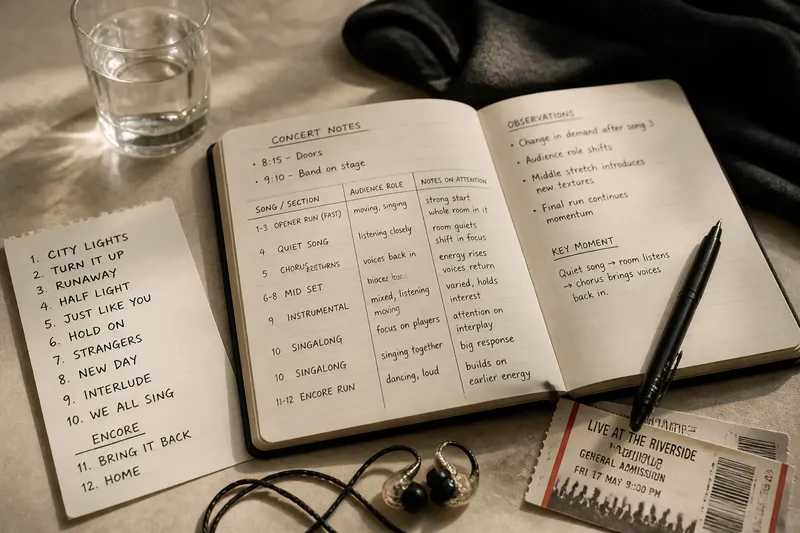
If you want to remember the sequence, jot down a handful of landmarks rather than trying to transcribe the whole set. Note the opening mood, one repeated sound, a noticeable change in delivery, and the later song that altered an earlier impression. These details preserve the journey’s shape better than a bare list of titles.
When a printed or posted set list is available, use it as a prompt, not a substitute for memory. Arrange your notes in playing order and draw a simple line between songs that seemed to speak to each other. A line can mark a direct musical echo or a contrast; add a question mark if you are unsure. That uncertainty is part of attentive listening, not a flaw to erase.
What should you listen for in a set list?
How can you spot a recurring musical idea?
Listen for a distinctive rhythm, melodic shape, vocal gesture, or instrumental sound returning in another song. Notice whether its new setting changes the mood or meaning you attached to it before.
Does a set list have to tell a story?
No. A sequence can feel connected through sound, energy, or contrast without forming a plot. It is enough to hear how one performance affects your response to the next.
What if I do not know the songs?
Follow the audible choices: the amount of space in the arrangement, the singer’s delivery, and sounds that recur. Familiarity with lyrics can add detail, but it is not required to hear the set’s shape.
How do I know if a later song answers an earlier one?
Look for a concrete echo, such as a returning melody or image, alongside a meaningful change in performance. Treat the connection as something you hear, not proof of what the artist intended.
Let the last connection stay open
A set list feels like a journey when its songs change one another in your memory. The clearest link may be a sound returning with a new weight; the most compelling one may be a contrast that refuses to resolve. After the concert, revisit the song that changed how you heard an earlier one. That is often where the sequence keeps moving, even after the room has gone quiet.