The Myth of the Perfect Concert Pace
Concert pace gains force through more than nonstop intensity. Learn to describe a live show's changing demands on attention and judge whether its energy develops.
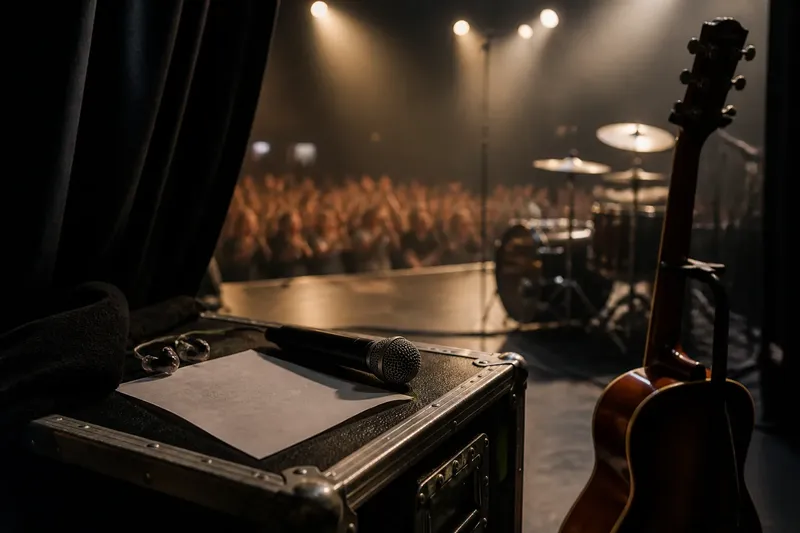
At a packed club, the singer finishes a fast song and the band launches straight into another. People are still moving, but a few faces turn toward the bar. Concert pace is not simply how often a room erupts; it is how a performance sustains attention. To write about concert pace, notice what the music asks listeners to follow, feel, or anticipate across the show.
Concert pace depends on more than volume
A loud passage can command a room, but loudness alone does not tell you whether the performance is moving forward. A quiet song may demand close attention to a lyric, while a driving instrumental stretch can keep listeners focused through the interplay between players. The useful question is not whether the energy is high, but whether the performance gives that energy purpose.
Look at how the band varies the work it asks the audience to do. A sequence might move from a shouted chorus to a song with a complicated rhythm, then to a familiar tune people can sing together. Each can hold attention in a different way. A long stretch of one kind of demand may feel absorbing to some listeners and tiring to others; describe the pattern you can hear rather than treating one response as universal.
When you review a show, name the audience’s changing role: listening closely, moving, singing, or waiting for a release. That makes a claim about pace more precise than calling a section “high energy.”
Judge a sustained section by how it develops
A set can hold one broad intensity for several songs and still feel purposeful. The musicians may vary the rhythmic feel, shift who carries the melody, or build a sequence of lyrical ideas. A steady stretch loses definition when its elements seem interchangeable, not merely because it avoids a slow song.
Imagine an invented show that opens with three brisk songs. In the first, the singer drives the chorus; in the second, the guitarist takes a longer solo; in the third, the audience carries the refrain while the band strips back the accompaniment. Starting with that run, you can compare the changing roles and listen for whether each song adds a distinct kind of engagement. If those changes are audible, the run has internal development; if the songs feel interchangeable, describe the sameness and where it sets in.
For a critic, a specific account of development is more useful than a verdict that a stretch “dragged.”
Use a listening plan to describe the show’s arc
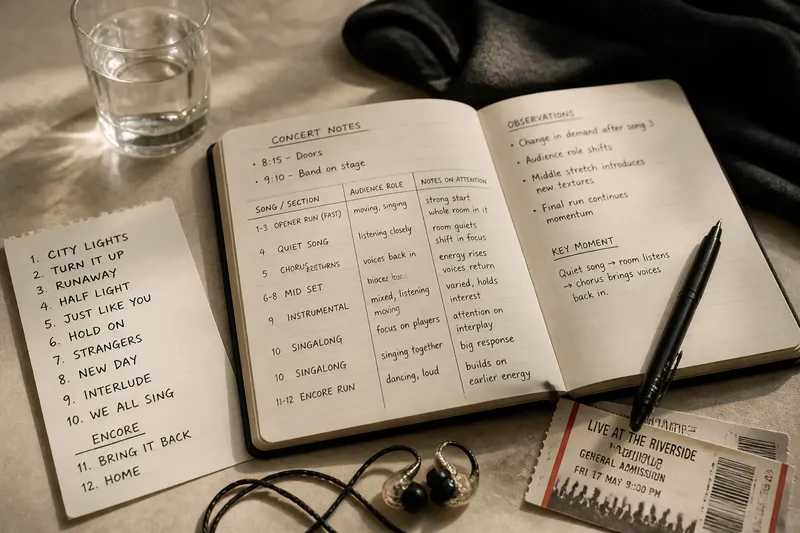
If a concert’s shape is hard to recall, make brief notes during the performance or listen to a recording afterward. Keep the focus on how attention changes, not on assigning scores to every song. For each item below, check the stated observation, then follow the decision that fits what you hear.
- Opening demand: Check whether the first songs ask for movement, close listening, or gradual orientation. If one mode dominates, note it as the starting point; if the demands vary early, describe that quicker shift.
- Audience role: Check whether people are singing, moving, listening quietly, or drifting toward distractions. If one response holds through a section, describe its sustained effect; if responses change, identify the moment and music that precede the change.
- Song-to-song distinction: Check whether adjacent songs differ in rhythmic feel, vocal approach, or audience participation. If they do, explain what separates them; if they do not, name the repeated feature and where it becomes noticeable.
- Middle stretch: Check whether the central run introduces new musical or emotional material. If it does, trace that development; if it stays on familiar ground, explain whether the performance varies its delivery or leaves the stretch static.
- Attention within a song: Check whether a listener’s focus shifts between voice, rhythm, instrumental detail, and group singing. If focus moves, describe the cue; if it stays fixed, decide whether that concentration feels absorbing or unvaried in context.
- Late-set momentum: Check whether the final run feels like a continuation, a change of direction, or a return to earlier material. If it builds on what came before, describe the link; if it feels detached, note what the set has not prepared the audience to hear.
- After-show account: Check whether your notes include a sustained stretch, a change in audience role, and a moment that altered your sense of the set. If all three are present, use them to explain the arc; if one is missing, revisit that part before making a broad claim about pacing.
Say you attend an invented club show whose first four songs all feature shouted choruses and brisk drums. Your starting input is that repeated pattern. First, note that the audience moves and sings through the opening; next, record that the next song shifts to a restrained vocal and a sparse keyboard part; then note that listeners grow quieter and the following chorus draws voices back in. The resulting account can say the opening established a strong group response, while the later change redirected attention before inviting participation again. If the quieter song had passed without any audible shift in audience behavior, the tradeoff would be different: you could describe it as a musical variation without claiming it changed the room’s engagement.
Describe the audience’s attention without speaking for everyone
A reviewer cannot know what every person in a room is thinking. You can, however, report observable signs: voices joining a refrain, people turning toward the stage, movement thinning, or conversation becoming more noticeable. Those details support a careful account without claiming that the crowd felt one thing as a whole.
Consider where you are standing, too. A person near the stage may be caught up in the singing while someone at the back is listening from a quieter distance. Instead of declaring that “the audience lost interest,” describe the visible change and the point in the performance when you noticed it. Then explain how that observation shaped your judgment of the set’s momentum.
Small, concrete observations make criticism fairer and more vivid.
Which questions help explain concert pace?
Does every set need a quiet song?
No. A set can vary its demands through changes in rhythm, vocal delivery, musical roles, or audience participation. A quieter song is only one way to change the experience.
Can a fast run of songs feel monotonous?
It can if the songs seem to offer the same musical and emotional experience. If the band changes the roles, rhythms, or audience response across the run, describe those distinctions before deciding the sequence feels repetitive.
How do I write about a show that felt uneven?
Identify the stretch where your attention changed, then describe what the performers and audience were doing around that point. That gives readers a reason for your judgment instead of a vague label.
Should a reviewer describe the crowd’s reaction?
Yes, when the reaction is observable and relevant to the performance. Describe what people did rather than assuming that every listener shared the same feeling.
Make a pacing judgment from the whole performance
A single song can feel flat while serving a larger stretch, or a thrilling moment can arrive without changing the character of the set around it. Keep the local impression and the broader pattern in view: what held attention, what shifted it, and whether the later performance developed what came before.
When you write about concert pace, return to the concrete sequence you observed. A clear account of who carried a song, how the audience responded, and what changed afterward helps readers understand the show’s movement without confusing constant intensity with lasting momentum.